
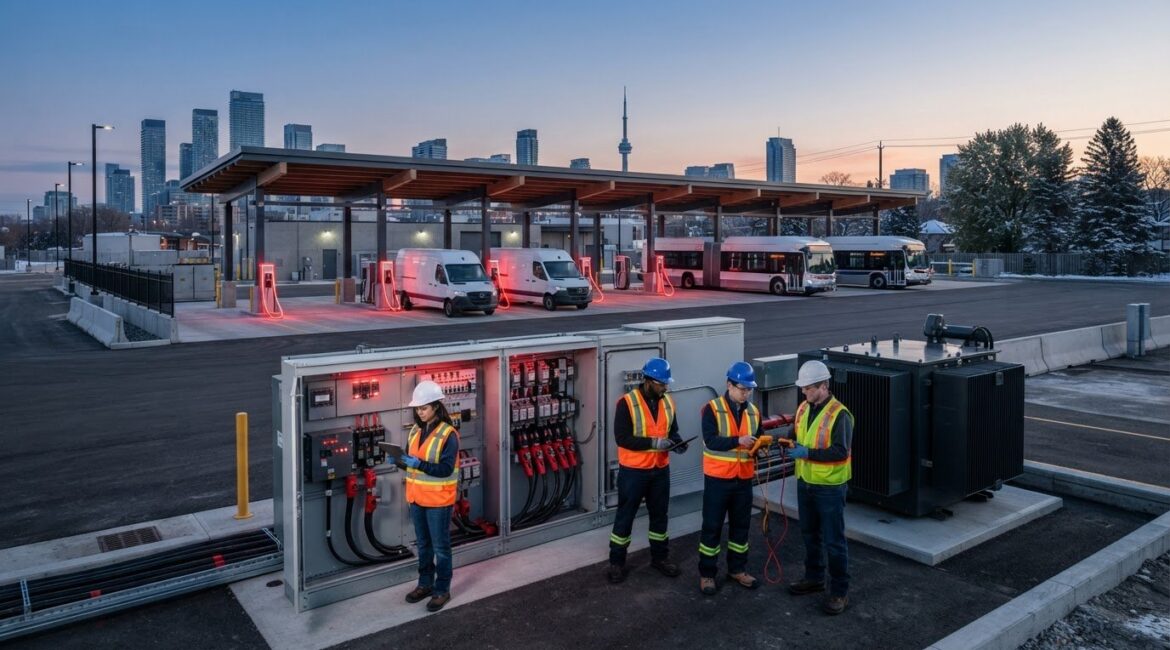
Depot fleet electrification succeeds or fails at the switchgear, not at the charger dispenser. For commercial yard operators, planning a successful fleet ev charging station installation ontario project rarely comes down to choosing vehicle plugs. It hinges on whether your main electrical service can handle continuous high-amperage draws without tripping breakers, triggering crippling utility demand surcharges, or forcing unexpected site downtime.
You already recognize the operational risk of running uncoordinated heavy charging loads on an aged distribution system. Balancing overnight depot schedules with peak delivery routes creates real friction, especially when local utility transformer constraints stall your rollout. You need an engineering approach that protects capital, maintains fleet uptime, and cuts straight through regulatory complexity.
In this comprehensive guide, you will discover how to engineer, permit, and install reliable commercial depot charging infrastructure across Ontario without costly grid bottlenecks or operational disruption. We break down precise facility load calculations, Ontario Electrical Safety Code mandates, local utility approval timelines, and the exact physical milestones required to bring your fleet online smoothly.
Key Takeaways
- Master accurate depot duty-cycle calculations to right-size the balance between overnight Level 2 charging and high-output DC fast charging.
- Identify facility distribution bottlenecks early, evaluating switchgear ampacity, continuous load limits, and customer-owned step-down transformers.
- Streamline your fleet ev charging station installation ontario project by aligning connection requests with Local Distribution Company frameworks like Toronto Hydro, Alectra, and Hydro One.
- Navigate mandatory Electrical Safety Authority (ESA) Plan Review triggers under the Ontario Electrical Safety Code to eliminate costly site work stoppages.
- Partner with specialized electrical engineering and master trade teams to execute turnkey yard infrastructure while safeguarding facility uptime.
Assessing Depot Power Demands: Commercial Fleet Charging Fundamentals in Ontario
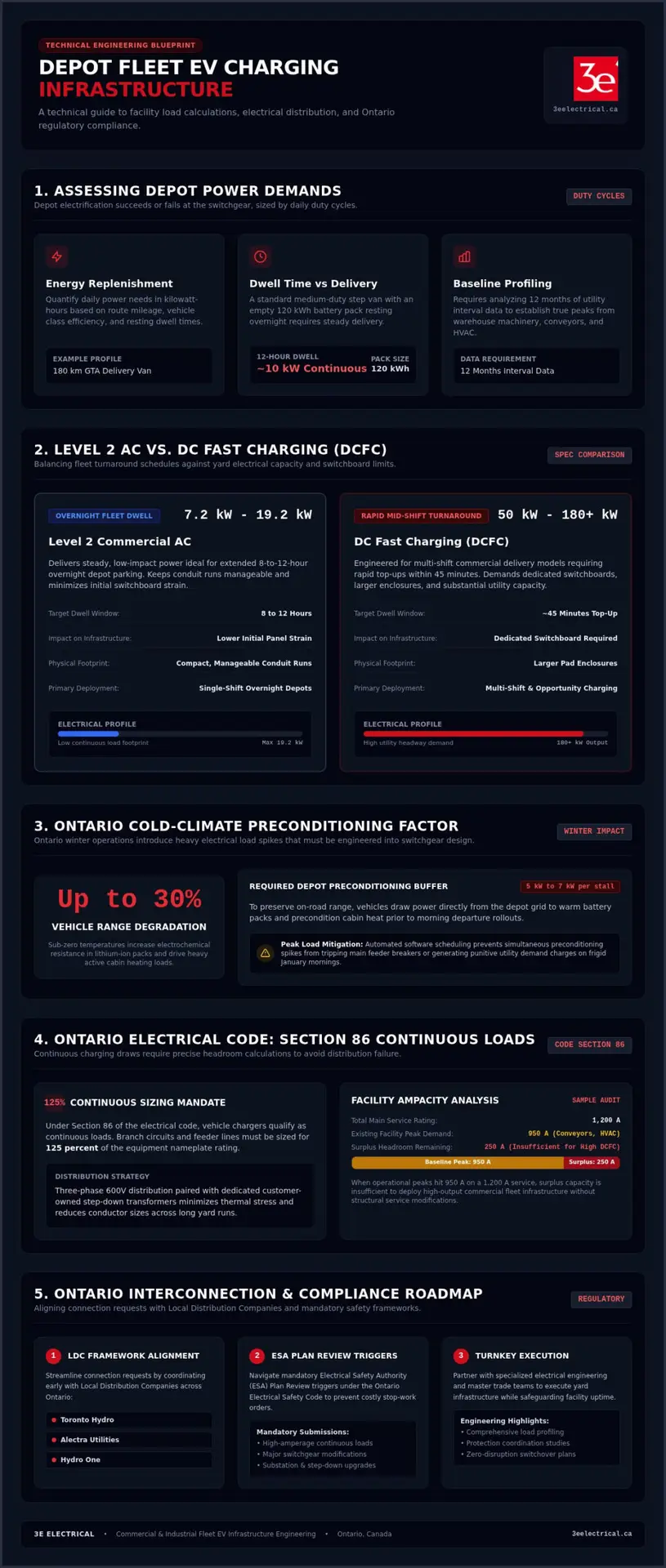
Every reliable depot rollout starts with duty cycles, not equipment catalogues. Before committing capital to physical hardware, you must quantify daily energy replenishment down to the kilowatt-hour. A delivery van logging 180 kilometres across the Greater Toronto Area consumes energy differently than a yard shunt truck operating intermittently over sixteen hours. Calculating daily consumption requires multiplying total route mileage by your vehicle class efficiency while factoring in yard dwell periods. If a medium-duty step van returns to your depot with an empty 120 kWh battery pack and sits idle for twelve hours, you need an average continuous delivery of roughly 10 kW. Attempting a comprehensive electric vehicle supply equipment deployment without matching route metrics directly to resting dwell times will either starve your distribution panel or leave expensive electrical capacity sitting idle.
Level 2 AC Versus DC Fast Charging for Depot Fleets
Hardware selection hinges entirely on turnaround schedules. Level 2 AC commercial chargers operate between 7.2 kW and 19.2 kW, delivering steady, low-impact power over extended eight-to-twelve-hour overnight dwell periods. They require less physical space, keep conduit runs manageable, and reduce initial panel strain. Conversely, DC fast chargers (DCFC) step output up from 50 kW to well over 180 kW. They serve multi-shift delivery models where vehicles require rapid mid-shift top-ups within forty-five minutes. However, DCFC installations demand dedicated switchboards, larger enclosures, and substantial utility headway. Selecting between them requires balancing fleet dwell availability against peak yard operational demand.
Cold-Climate Battery Preconditioning Demands
Ontario winters alter electrical load profiles dramatically. When temperatures drop below freezing, electrochemical resistance slows lithium-ion intake while active cabin heating draws heavily on stored energy. Cold weather can degrade vehicle range by up to thirty percent if unaddressed. To preserve mission-critical range on the road, vehicles must draw power directly from the depot grid to precondition cabin heat and warm battery packs prior to morning departure. Factoring preconditioning into a fleet ev charging station installation ontario project requires allocating an extra 5 kW to 7 kW per stall during scheduled morning rollouts. Implementing automated software scheduling prevents simultaneous preconditioning spikes from tripping main feeder breakers or generating punitive utility demand charges on frigid January mornings.
Depot Electrical Infrastructure Upgrades: Transformers, Switchgear, and Panels
A disciplined facility assessment determines whether your current distribution gear can support expanded charging operations. Installing a fleet ev charging station installation ontario project requires auditing existing main breakers, switchboards, and service entrance conductors. Comprehensive service upgrades expand facility capacity and eliminate dangerous thermal stress without risking catastrophic system overloads. When existing switchgear runs near peak capacity, adding continuous charging loads without structural modifications creates immediate reliability hazards.
Calculating Facility Peak Demand and Available Ampacity
Accurate load profiling begins by analyzing twelve months of utility interval data. This establishes true baseline demand across seasonal operating peaks, accounting for warehouse conveyors, heavy machinery, and HVAC cycles. Available ampacity is what remains between this operational peak and the continuous rating of your main service switchboard. Under Section 86 of the electrical code, vehicle chargers qualify as continuous loads, meaning circuits must be sized for 125 percent of the equipment nameplate rating. If your depot features a 1,200 A service but operational peaks hit 950 A, surplus capacity is insufficient to deploy high-output commercial fleet charging infrastructure safely. Depot managers must identify these thresholds before procurement begins.
Three-Phase 600V Distribution and Step-Down Transformers
Depot yard distribution across Ontario relies primarily on 347/600 V three-phase power to minimize line losses across extended distances. Legacy facilities wired strictly for 120/208 V struggle to move bulk power without massive, costly copper feeders. Stepping up to 600 V distribution allows depot operators to push high amperage across outdoor parking stalls with minimal voltage drop. However, because most commercial DC fast chargers operate on 277/480 V configurations, facilities typically require customer-owned, dry-type step-down transformers to bridge the voltage gap.
- Main Service Ratings: Modernize main switchgear from legacy 600 A or 800 A assemblies to 1,600 A or 2,000 A switchboards to create long-term headroom.
- Step-Down Isolation: Specify heavy-duty 600 V to 480 V or 600 V to 208 V dry-type transformers to safely feed dedicated charger subpanels.
- Feeder Protection: Install dedicated distribution feeder breakers engineered for continuous commercial duty cycles and high fault currents.
Identifying these requirements early prevents unbudgeted site delays. If your distribution system cannot support additional electrification, scheduling engineering-led panel and service upgrades ensures your yard switchgear handles severe continuous charging loads with absolute stability.
Navigating Ontario Utility Interconnections and LDC Requirements
Your depot electrical room does not operate in isolation. Connecting significant high-amperage hardware links your facility directly to the regional electrical grid. Engaging your Local Distribution Company (LDC), such as Toronto Hydro, Alectra Utilities, or Hydro One, must happen during preliminary planning rather than after buying hardware. Large depot projects frequently trigger transformer replacements or overhead-to-underground primary conversions. Alignment with statutory Ontario EV charger installation requirements ensures grid engineering reviews commence before trenchers arrive on site.
The Local Distribution Company (LDC) Application Process
The path toward utility approval follows structured regulatory milestones governed by the Ontario Energy Board. Commercial facilities must submit formal load calculations and single-line diagrams to secure grid allocation. Under standard utility timelines, LDCs evaluate application completeness within 14 days and typically require 60 to 90 days to issue a formal connection study if feeder expansion is involved.
- Connection Request: Provide historical peak interval data alongside projected coincident vehicle charging demand to initiate technical reviews.
- Offer to Connect (OTC): Review utility infrastructure requirements, shared capital costs, and transformer allocations before signing construction commitments.
- Civil Coordination: Align primary duct bank excavations and utility concrete pad pours with on-site depot trenching schedules.
Rigorous coordination eliminates costly downtime. A well-managed timeline keeps equipment delivery, utility transformer setting, and yard energization working in total lockstep.
Mitigating Ontario Demand Charges and Global Adjustment
Uncontrolled depot charging triggers extreme operational expense. If thirty delivery vans plug in concurrently at 5:00 PM when warehouse conveyor systems and heating equipment run at full blast, the resulting spike resets your facility peak demand billing for the entire billing cycle. Commercial depots consuming heavy power face steep exposure to Ontario capacity charges and Global Adjustment costs. Implementing automated Energy Management Systems (EMS) eliminates this financial exposure by capping total depot draw below predetermined peak thresholds.
Dynamic load management schedules non-critical charging across overnight, off-peak windows. This operational discipline is vital when executing a comprehensive fleet ev charging station installation ontario plan. Using centralized orchestration software throttles dispenser output instantaneously whenever base building electrical demand surges. Your vehicles still achieve full target charge states prior to early morning dispatch, but your facility avoids resetting regional peak demand records that punish your monthly operating balance sheet.
Regulatory Compliance: ESA Plan Review and Ontario Electrical Safety Code
Commercial electrification demands absolute regulatory compliance before a single trench is opened. In Ontario, commercial fleet charging installations operate under the strict governance of the 29th edition of the Ontario Electrical Safety Code (OESC 2024 / Ontario Regulation 164/99). Cutting corners on provincial mandates leads directly to stop-work orders, failed utility energization, and invalidated commercial property insurance. Every high-capacity fleet ev charging station installation ontario project requires an orderly progression through provincial review channels, ending only when the inspector signs your formal Certificate of Acceptance.
Navigating Mandatory ESA Plan Review Submissions
Under OESC Rule 2-010, an Electrical Safety Authority (ESA) Plan Review submission is legally mandatory prior to starting work whenever the combined nameplate rating of new and existing charging equipment exceeds 20 percent of the facility’s service equipment rating. Depots adding substantial continuous load routinely cross this line. Plan Review is also triggered automatically for three-phase services rated at 400 A or greater, single-phase services at 600 A or greater, or any installation incorporating medium-voltage substations. Submissions through the ESA Electronic Plan Review portal require single-line diagrams, fault current calculations, short-circuit ratings, and branch panel layouts. Addressing technical engineering inquiries early keeps field trades working without costly project halts.
OESC Section 86 and Physical Yard Safety Standards
Section 86 establishes the precise physical parameters for vehicle charging systems. Branch circuits supplying commercial charging dispensers must be dedicated exclusively to that purpose, sized for continuous duty, and equipped with a locking disconnect switch positioned within sight of the equipment. Outdoor depot environments also introduce significant mechanical hazards that demand robust physical protection:
- Vehicle Impact Protection: Shield charging pedestals and switchgear enclosures with heavy-duty, concrete-filled steel bollards and concrete wheel stops engineered to deflect yard collisions.
- Trenching and Burial Depths: Maintain code-compliant underground cover depths beneath asphalt or concrete surfaces subject to commercial heavy-vehicle traffic, utilizing rigid PVC or encased conduit runs.
- Ground Fault and Disconnecting Means: Ensure each supply feeder provides code-compliant ground fault protection alongside readily accessible emergency power disconnects.
Physical construction closes with formal site audits. The ESA inspector reviews conduit seals, verifies conductor torque markings, and checks disconnect clearances before issuing a final Certificate of Acceptance. If your yard requires comprehensive electrical assessments to satisfy provincial standards, engage a licensed team for professional EV charger installations that deliver total code compliance from initial drawings to energization.
Engineering Turnkey Depot Charging with 3e Electrical
Executing fleet electrification successfully requires an electrical trade partner that bridges engineering theory and field execution. Many providers act merely as brokers, subcontracting physical wiring to disconnected third parties. 3e Electrical operates differently. Led by a Professional Engineer (P.Eng.) and licensed Master Electricians, our team handles commercial electrification directly across Toronto, Mississauga, Etobicoke, and North York. We deliver end-to-end execution, ensuring your switchgear, distribution feeders, and charging pedestals are engineered for longevity and full provincial compliance.
Master Electrician and Engineering Leadership
Complex high-voltage yard retrofits cannot rely on guesswork. Engineering oversight from project inception guarantees your switchgear upgrades and load calculations reflect rigorous technical standards. Our dual engineering and master trade background ensures seamless coordination between primary utility services, interior distribution switchboards, dry-type step-down transformers, and outdoor charger banks. We optimize your existing service capacity first, identifying practical ways to expand throughput before recommending massive utility overhauls. Managing both technical design and field wiring in-house eliminates miscommunication, prevents scheduling friction, and delivers complete accountability at every phase.
Executing Your Ontario Fleet Electrification Plan
Minimizing yard downtime requires disciplined staging. We establish a clear, multi-phase construction roadmap tailored around your daily vehicle dispatch schedules. Civil trenching, concrete pad construction, and conduit runs proceed systematically to keep operational logistics bays clear. For mission-critical operations that cannot risk power interruptions, we also integrate emergency back-up generators and automatic transfer switches to protect facility continuity during severe regional outages.
- Phase 1: Site Feasibility and Load Profiling: On-site load measurement, utility interval data analysis, and transformer capacity verification.
- Phase 2: Permitting and Utility Alignment: Complete preparation of single-line diagrams, LDC connection requests, and ESA Plan Review filings.
- Phase 3: Heavy Infrastructure Upgrades: Installation of main service switchgear, step-down transformers, underground feeder raceways, and protection bollards.
- Phase 4: Hardware Commissioning: Charger mounting, breaker calibration, automated load management integration, and ESA Certificate of Acceptance sign-off.
Your transition to commercial electric transportation should build operational resilience, not operational friction. When you are ready to engineer a robust fleet ev charging station installation ontario project built to last, contact 3e Electrical to schedule an on-site commercial fleet charging assessment with our engineering and master electrician team.
Build Resilient Depot Charging with Engineering Precision
Scaling a commercial yard demands robust infrastructure from the utility connection down to the physical charging stall. Successful electrification requires accurately balancing vehicle dwell cycles, sizing switchgear for continuous demand, and proactively securing utility approvals. When you build with precision from day one, your yard runs efficiently without the risk of blown breakers or costly electrical surcharges.
Executing a reliable fleet ev charging station installation ontario project calls for seasoned technical leadership. 3e Electrical is led by a Professional Engineer (P.Eng.) and licensed Master Electricians. We deliver complete turnkey execution, handling heavy commercial panel upgrades, civil trenching, and EV charging infrastructure under one roof. Our team manages comprehensive compliance across mandatory ESA Plan Review submissions and the Ontario Electrical Safety Code, keeping your operations fully protected.
Your vehicles have routes to run. Don’t leave depot power capacity to chance. Schedule an on-site commercial fleet EV charging assessment with 3e Electrical to build an electrical foundation that keeps your fleet moving smoothly.
Frequently Asked Questions
How much spare electrical capacity does an Ontario commercial facility need to install fleet EV chargers?
A commercial facility needs surplus ampacity calculated at 125 percent of the continuous load rating of each added charging port. Under the Ontario Electrical Safety Code, EV chargers qualify as continuous loads. For example, ten 40-amp Level 2 chargers require 500 amps of dedicated 208V capacity. A professional review of your interval peak data confirms whether existing distribution switchboards can handle this draw safely or require service upgrades.
What is an ESA Plan Review, and is it mandatory for commercial fleet charging installations?
An ESA Plan Review is an engineering safety audit conducted by the Electrical Safety Authority prior to physical construction, and it is mandatory for most depot installations. Under OESC Rule 2-010, review is legally enforced when new charging capacity exceeds 20 percent of the facility’s existing service rating, or involves three-phase services rated at 400 A or higher. Single-line drawings and fault calculations must be submitted through the Electronic Plan Review portal.
Can our depot install Level 2 chargers without upgrading our main utility transformer?
Yes, depots can frequently deploy Level 2 chargers without utility transformer overhauls by utilizing an Electric Vehicle Energy Management System (EVEMS). Under OESC Rule 8-106, dynamic load management monitors facility consumption in real time and automatically throttles charging speeds when building power demands spike. This engineering approach maximizes existing ampacity during overnight off-peak periods, allowing fleets to execute a cost-effective fleet ev charging station installation ontario project without funding expensive substation expansions.
How does smart load management prevent expensive commercial peak demand charges in Ontario?
Smart load management eliminates demand spikes by capping aggregate charging draws and scheduling replenishment outside facility peak operating hours. Ontario utilities assess substantial monthly demand charges based on your facility’s highest 15-minute power peak. Centralized load controllers stage charging overnight or sequence power delivery among parked fleet vehicles. This prevents simultaneous charging from stacking onto HVAC or warehouse equipment loads, avoiding punitive peak billing while meeting morning dispatch schedules.
How long does the utility connection and approval process take with LDCs like Toronto Hydro or Alectra?
Securing commercial utility connection approvals across Ontario typically takes between two and four months, depending on local feeder capacity. Local Distribution Companies like Toronto Hydro, Alectra Utilities, and Hydro One complete preliminary reviews within 14 days under Ontario Energy Board guidelines. If grid reinforcement or a dedicated pad-mounted transformer is required, formal connection impact studies take an additional 60 to 90 days. Early engineering coordination prevents yard commissioning delays.
What physical safety protections are required for outdoor commercial EV charging pedestals in Ontario?
Outdoor depot pedestals require mechanical vehicle impact barriers, dedicated weatherproof disconnects, and code-compliant underground feeder conduit burial. Section 86 of the Ontario Electrical Safety Code mandates a lockable disconnect switch within sight of each charger. Yards must install concrete-filled steel crash bollards or wheel stops to protect equipment from vehicle strikes. For a compliant fleet ev charging station installation ontario rollout, underground feeder lines beneath asphalt surfaces must maintain strict code-specified trench depths.