DC Fast Charging for Business.
Assessed honestly, installed right.
A DC fast charger installation in Toronto is the fastest way to charge an EV — and the most demanding thing you can plug into your building. Before you buy hardware, 3e tells you the truth about what your site can actually support.
ECRA 7014948
10-year workmanship warranty
4.9 stars from 200+ reviews
Level 3 charging, in plain terms
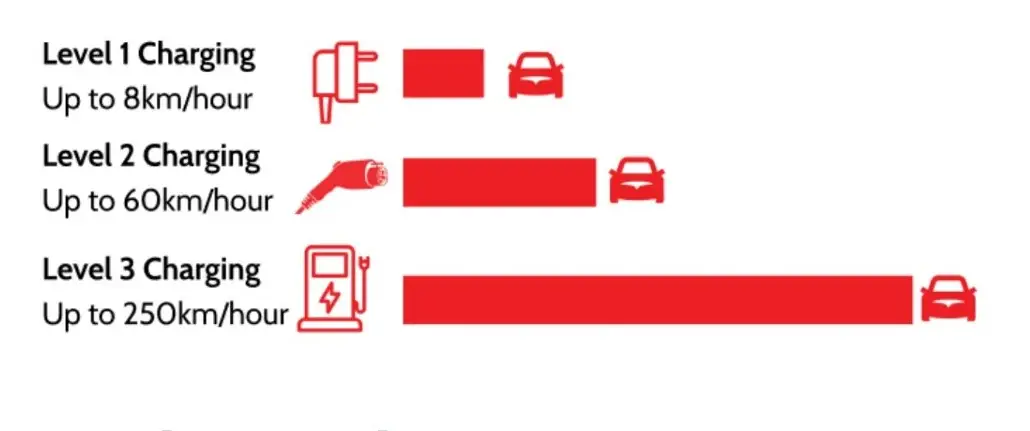
Level 3 — also called DC fast charging — delivers direct current straight to an EV’s battery, bypassing the vehicle’s onboard AC converter. That’s what makes it fast: most EVs can charge to about 80% in roughly 15 to 30 minutes, compared to hours on a Level 2 charger.
That speed comes at a cost. A DC fast charger typically runs on 480-volt three-phase service and can draw as much power as a small building. It needs serious electrical infrastructure, utility coordination, permits — and honest engineering judgement about whether your site is a good fit.
That last part is where 3e comes in. We’re electrical contractors first. We assess your building’s service capacity before we quote, so you never buy a charger your site can’t feed.

DC fast charging station (illustrative photo, Wikimedia Commons, CC-BY-SA-4.0)
Businesses where fast charging pays
Level 3 isn’t for every business. It’s for businesses where vehicle turnaround time is money — or where fast charging draws customers through the door.
Fleet depots & logistics
Delivery vans, service trucks and courtesy vehicles that need quick turnaround between runs. Fast charging keeps your fleet moving instead of parked.
Retail centres & malls
EV drivers choose where they stop based on chargers. A fast-charging bay turns a 20-minute charge into a 20-minute shopping visit.
Hotels & hospitality
Guests increasingly expect charging as an amenity. Fast chargers serve short-stay visitors and rental-car fleets without tying up stalls all night.
Restaurants & gas stations
Charge time equals dwell time. A fast charger at your location converts a fuel stop into a meal, a coffee, or a convenience-store basket.
Office buildings & workplaces
A shared fast charger supports tenant EVs and visiting clients — and signals a serious sustainability commitment, not a token gesture.
Taxis, rideshare & high-mileage fleets
Buses, taxis, rideshare and car-share vehicles that run all day can’t wait hours to charge. Level 3 is built for exactly that duty cycle.
What a DC fast charger installation in Toronto asks of your building
This is the part most sales pitches skip. A Level 3 charger is a major electrical load — feasibility depends on your site, not your enthusiasm. Here’s what 3e evaluates during a site assessment:
480V three-phase service
DC fast chargers run on commercial three-phase power. We’ll confirm what your building actually has coming in — and whether the available capacity is enough.
Service capacity & load study
One charger can draw as much as a small building. We measure your existing loads and peak demand to see if there’s headroom — or if a service upgrade is needed first.
Utility coordination
In Toronto and the GTA, adding this kind of load usually means coordinating with your utility (e.g. Toronto Hydro) — sometimes including new transformers or service upgrades. We manage that process.
Space, civil work & layout
Chargers, concrete pads, bollards, trenching, conduit runs across the lot, signage and accessible stalls — the electrical work is only half the project. We plan the whole site.
Permits & ESA compliance
Commercial EV charging installations in Ontario must comply with the Ontario Electrical Safety Code. 3e handles the ESA notification and inspection process end to end.
Networking & payment
If you plan to charge drivers for charging, the station needs network connectivity for payment processing and usage reporting. We integrate the hardware with your billing setup.
Assessment first. Quote second. No exceptions.
DC fast charging projects fail when someone sells you hardware before understanding your building. We do it the other way around.
Free site assessment
We visit your property, review your electrical service, and talk through what you’re trying to achieve — fleet charging, customer amenity, or both.
Honest feasibility verdict
We tell you what your site can support: how many chargers, at what power, and what upgrades would be needed. If Level 2 is the smarter move, we’ll say so.
Engineered design & quote
A single fixed quote based on your site’s real conditions — charger selection, civil work, utility coordination, permits and commissioning. Value-engineered, not padded.
Install & commission
Licensed ESA electricians install the system, handle inspections, and commission the chargers — backed by our 10-year workmanship warranty.
“If your business depends on the speed of charge, then yes — invest in Level 3. But if your vehicles can sit for a few hours or overnight, Level 2 will almost certainly do the job for a fraction of the cost.”
Marcello Piccinato, P.Eng, Master Electrician — President, 3e Electrical
Level 2 vs. Level 3 — which does your business actually need?
Not every commercial site needs DC fast charging. Here’s the straight comparison we walk clients through.
| Level 2 (AC) | Level 3 (DC fast) | |
|---|---|---|
| Typical charge time | Hours — vehicles charge over a shift or overnight | Roughly 15–30 minutes to about 80% |
| Electrical service | 208–240V, modest load per charger | 480V three-phase, very high load |
| Best for | Employee parking, overnight fleets, tenant parking | Public-facing sites, quick-turnaround fleets, high-traffic locations |
| Project complexity | Usually straightforward | Major — utility coordination, permits, civil work |
| Cost profile | Far lower hardware and install cost | Significantly higher — hardware, infrastructure and upgrades |

FLO fast chargers at a Canadian business location (photo: EVmagz coverage of FLO’s Tim Hortons rollout)
Our rule of thumb: if vehicles dwell for hours anyway — employee lots, overnight fleets, tenant parking — Level 2 chargers cost far less and do the job. Level 3 earns its keep where speed matters: public locations, high-turnover parking, and fleets that can’t wait.
We’ll help you make that call based on your actual duty cycle and site — not on which hardware has the bigger margin.
Questions business owners ask us
Straight answers about Level 3 EV charging in Toronto and the GTA.
No. DC fast chargers draw far more power than any residential service can supply — they need 480V three-phase commercial service. For a home, Level 2 is the right solution: it charges a typical EV overnight for a fraction of the cost. This page is for commercial properties, fleet operators and high-rise buildings.
A DC fast charger needs three-phase power — typically 480V — plus significant spare capacity on your building’s service. That’s why every project starts with a site assessment: we measure your existing loads and peak demand, then determine whether your service can support a charger, or whether an upgrade (coordinated with your utility) is needed first.
It varies widely — charger count, power level, distance from your electrical room, civil work, and whether your utility needs to upgrade service all swing the number. That’s exactly why we don’t publish a price list: a free site assessment is the only honest way to scope it. You’ll get one fixed quote based on your site’s real conditions, not a guess.
Federal, provincial and utility incentive programs come and go — Ontario’s EV ChargeON program has opened and closed to applicants in past rounds. Programs are time-sensitive, so we recommend checking current availability; during your assessment we’ll flag any programs that look relevant to your project.