
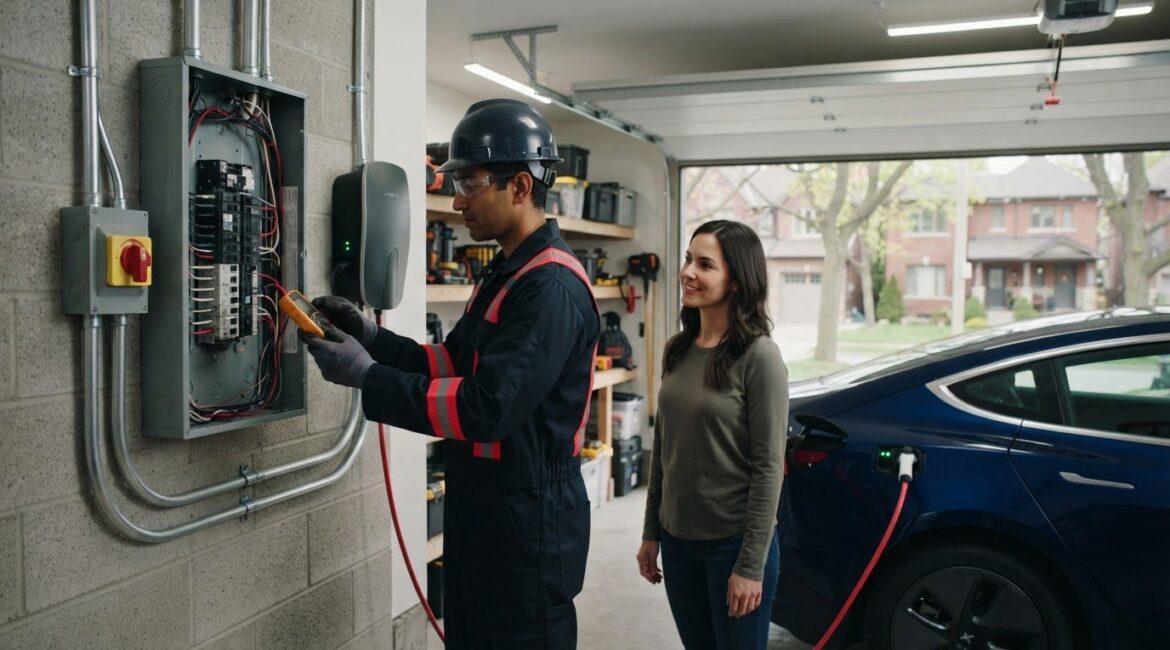
Over 80 percent of electric vehicle charging in Canada takes place at home overnight, yet roughly half of older detached homes across Ontario still operate on 100-amp service panels. If you have recently brought an electric vehicle home, planning your residential ev charger installation brings up immediate, practical questions. Your home needs to support that sustained draw safely, without compromise.
You want the simplicity of waking up to a full battery every morning. Even so, sorting through technical jargon, continuous load rules, and Electrical Safety Authority (ESA) mandates can feel daunting. Wondering whether your existing panel can shoulder the extra demand is a valid concern, especially when property protection and home insurance coverage are on the line.
This guide breaks down exactly how Level 2 charging infrastructure works, what your electrical panel requires, and how proper ESA certification shields your investment. Ahead, you will find a straightforward roadmap covering load calculations, smart energy management, and the exact steps to power your vehicle safely and reliably.
Key Takeaways
- Understand why a dedicated 240V Level 2 system is essential for reliable vehicle range, especially during freezing Ontario winters.
- Learn how an engineering load calculation determines whether your existing panel can support charging or requires an energy management device.
- Clarify the legal necessity of an Electrical Safety Authority (ESA) permit to safeguard your property and maintain valid home insurance.
- Evaluate the performance and safety advantages of hardwired connections compared to standard plug-in receptacles.
- Review the complete roadmap for a compliant ev charger installation, from the initial technical site assessment to final power-on.
Understanding Level 2 EV Charger Installation for Your Home
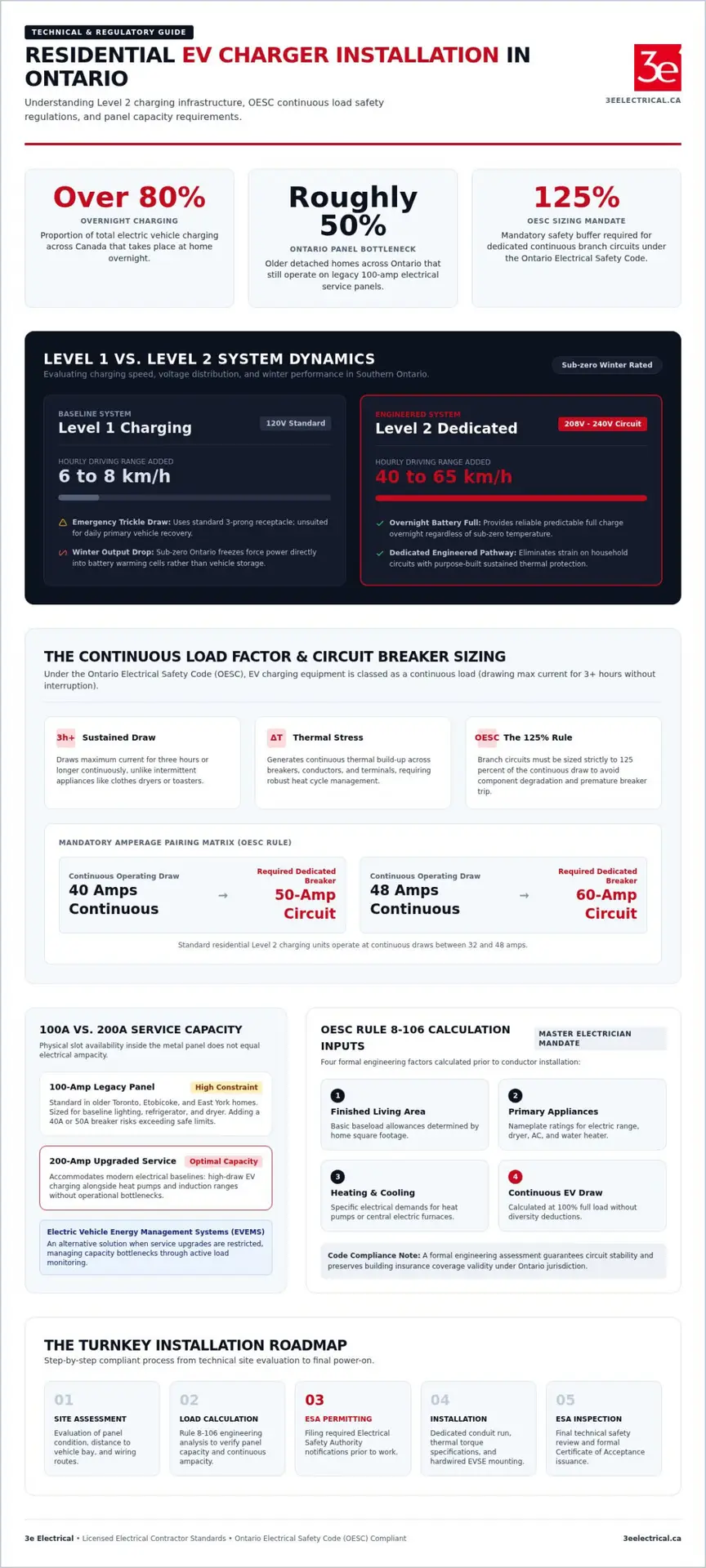
Plugging an electric car into a standard wall socket works in an emergency. Daily life requires something far more robust. A dedicated Level 2 setup transforms home charging from an overnight trickle into an efficient, predictable routine. Instead of running on 120 volts, a Level 2 system operates on a dedicated 208-volt to 240-volt circuit. That added voltage delivers substantial power directly to your vehicle’s onboard battery management system.
Modern electric vehicles demand purpose-built infrastructure. They are not ordinary household appliances. An ev charger installation establishes an engineered power pathway, ensuring current flows safely for hours without stressing your home’s distribution panel.
Level 1 vs. Level 2 Charging: Speed and Efficiency Differences
Level 1 charging relies on a standard three-prong outlet, adding a modest 6 to 8 kilometres of driving range per hour. When Southern Ontario winter hits, that output drops drastically. Sub-zero temperatures force the vehicle to divert incoming electricity toward internal battery warming systems just to keep the cells receptive. Little power remains to actually fill the pack. In contrast, a 240V Level 2 charger supplies 40 to 65 kilometres of range hourly. Your vehicle charges completely overnight, regardless of external freeze.
The Continuous Load Factor: Why EV Circuits Are Unique
Circuits in residential homes operate under distinct thermal rules. The Ontario Electrical Safety Code (OESC) classifies electric vehicle supply equipment as a continuous load. This classification fundamentally alters circuit design.
- Sustained Draw: A continuous load draws maximum current for three hours or longer without interruption.
- Thermal Stress: Unlike intermittent loads such as clothes dryers or toasters, sustained draw generates ongoing thermal buildup across breakers, conductors, and terminals.
- The 125 Percent Rule: Branch circuits must be sized to 125 percent of the continuous draw. A 40-amp charging station requires a 50-amp dedicated breaker, while a 48-amp charger demands a 60-amp circuit.
Every element in a Level 2 circuit must withstand extended heat cycles. Proper conductor sizing, torque specifications, and breaker selection prevent premature component fatigue. Professional engineering ensures that this rigorous demand remains entirely stable within your home.
Assessing Electrical Panel Capacity and Dedicated Circuit Demands
Before installing high-amperage equipment, you must assess what your home can safely distribute. An ev charger installation demands a major allocation of power. Standard residential chargers draw between 32 and 48 amps continuously, which places significant structural demand on your main service distribution.
Evaluating 100-Amp vs. 200-Amp Residential Service
Many brick homes across Toronto, Etobicoke, and East York still run on 100-amp service. These panels were originally designed for modest electrical baselines: basic lighting, a refrigerator, and perhaps a clothes dryer. Adding a 40-amp or 50-amp breaker for an electric vehicle can push total household demand past safe operating limits. Upgrading to a 200-amp service provides ample breathing room for modern living, accommodating electric vehicle charging alongside heat pumps and induction ranges. When needed, professional teams handle panel and service upgrades in coordination with your local distribution utility.
Residential Load Calculations Under Ontario Code
You cannot simply count empty breaker slots to determine panel capacity. Physical space inside the metal enclosure does not equal electrical ampacity. Under the Ontario Electrical Safety Code (OESC Rule 8-106), a Master Electrician must perform a formal residential load calculation before pulling conductors. This engineering calculation accounts for several specific inputs:
- Living Area: Basic load allowances determined by your home’s total finished square footage.
- Primary Appliances: Nameplate ratings for your electric range, clothes dryer, water heater, and central air conditioning.
- Heating and Cooling Demands: Baseload allowances for electric furnaces or ductless heat pumps.
- Continuous EV Draw: Factoring the vehicle charger at 100 percent load without diversity deductions unless regulated by automated controls.
Energy Management Systems: Solving Panel Capacity Bottlenecks
When a main panel lacks capacity for a direct circuit addition, an Electric Vehicle Energy Management System (EVEMS) offers a smart solution. Formally approved under OESC Bulletin 86-1-7, an EVEMS continuously reads incoming service draw via current sensors. If domestic power consumption spikes while you run heavy appliances, the device automatically pauses or throttles the charging station. Once household demand drops, charging resumes at full speed. This intelligent hardware protects your infrastructure from overload while avoiding immediate service replacements.
Navigating Ontario Electrical Safety Authority (ESA) Permits and Compliance
Under Ontario law, high-voltage residential electrical work must satisfy strict provincial safety standards. Installing dedicated vehicle charging equipment is not an informal household project. Under Ontario Regulation 164/99, an ev charger installation requires an official permit filed with the Electrical Safety Authority (ESA) before physical work begins. Compliance protects your family, your physical structure, and your property value.
The Mandatory ESA Notification Process in Ontario
An electrical permit is formally known as a Notification of Work. This filing establishes an official record of electrical alteration with provincial safety authorities. By law, only the registered homeowner or a Licensed Electrical Contractor (LEC) can open an installation permit. When hiring a professional for an ev charger installation, the contractor manages the initial filing, coordinates the inspection timeline, and ensures the installation satisfies every code requirement from start to finish.
Why a Licensed Electrical Contractor Is Mandatory
Hiring a general handyperson to install charging equipment violates Ontario law. The province requires specialized trade credentials for good reason. High-voltage, continuous-draw installations carry distinct risks that demand specialized engineering oversight.
- Legal Authority: Only an LEC registered with ECRA/ESA and holding an active seven-digit licence number can legally perform electrical work for hire.
- Master Electrician Oversight: Licensed contractors operate under designated Master Electricians who maintain thorough command of the Ontario Electrical Safety Code.
- Liability Protection: Legitimate contractors carry verified commercial general liability insurance and valid WSIB clearance. Unlicensed workers expose you to direct financial liability for property damage or physical workplace injuries.
Insurance Protection and the ESA Certificate of Acceptance
Once installation finishes, an ESA inspector evaluates the physical conductors, connections, and overcurrent devices. Passing this evaluation triggers the release of an official Certificate of Acceptance. This paper record carries decisive legal and financial weight.
Insurance underwriters across Ontario evaluate electrical fire claims under strict terms. If an electrical failure stems from unpermitted wiring, insurers can lawfully dispute or deny the claim. That leaves the homeowner fully exposed to catastrophic loss. Retaining an ESA certificate confirms verified code compliance, keeps your property insurance valid, and provides clear proof of workmanship during future home resale disclosures.
Choosing Between Hardwired and Plug-In EV Charging Stations
Homeowners often weigh portable flexibility against permanent stability when planning an ev charger installation. While both approaches provide Level 2 power, the mechanical differences between a hardwired connection and a plug-in receptacle directly affect your system’s long-term durability and continuous electrical output.
Hardwired Installations: Maximum Output and Mechanical Durability
A hardwired setup connects conductors directly from your distribution panel into the charging unit’s internal terminal blocks. By removing intermediary contact points, you eliminate loose plug blades, socket tension fatigue, and localized thermal buildup. Hardwiring enables charging speeds up to 48 amps (11.5 kW) when paired with a dedicated 60-amp circuit breaker. The structural enclosure seals tightly against seasonal elements, making hardwiring the premier choice for outdoor driveway posts and unheated detached garages across Ontario.
Plug-In Installations (NEMA 14-50): Portability vs. Electrical Constraints
Plug-in chargers connect via a heavy-duty NEMA 14-50 wall receptacle. While this allows you to disconnect the charging hardware for travel, it introduces distinct mechanical and regulatory limits:
- Amperage Caps: Continuous draw through a 50-amp receptacle circuit is legally capped at 40 amps (9.6 kW). On a 40-amp circuit, actual continuous delivery stops at 32 amps.
- Nuisance Tripping: The Ontario Electrical Safety Code mandates GFCI breaker protection on 240V residential receptacles. Because modern EV chargers include built-in ground fault monitoring, the two safety systems can conflict, causing frequent nuisance tripping.
- Receptacle Degradation: Sustained electrical current places severe thermal stress on mechanical socket contacts. Standard residential-grade outlets can overheat or melt, requiring commercial-grade hardware rated for continuous duty.
Strategic Placement: Garage Walls vs. Outdoor Weatherproof Mounts
Positioning your station requires careful physical planning. Map the direct pathway between your charger location and your vehicle’s charge port, accounting for whether you back into your stall or pull in forward. Cables should rest comfortably on the ground rather than stretching taut across active walking paths. For exterior installations, equipment must feature a certified NEMA 3R or NEMA 4X enclosure to withstand blowing snow, road salt spray, and torrential rain.
To establish a clean, code-compliant charging setup tailored to your home layout, you can schedule a professional ev charger installation with certified electrical specialists.
The Turnkey Installation Process from Site Assessment to Power-On
Transforming raw electrical capacity into a seamless daily charging routine requires a systematic approach. A professional ev charger installation balances electrical engineering calculations with disciplined field execution. Every connection must perform reliably under sustained, continuous current.
Step 1: Thorough Site Audit and Infrastructure Planning
The process starts with an in-depth on-site audit. A Master Electrician reviews your main service panel, inspects bonding and grounding electrodes, and calculates spare capacity. The physical pathway between the electrical panel and your desired charging stall is measured. Conductor gauges are formally specified; a continuous 48-amp draw demands heavy copper conductors, typically 6 AWG or 4 AWG depending on distance and ambient run temperatures. Pathways are planned to preserve property aesthetics while ensuring mechanical defense.
Step 2: Circuit Routing, Mounting, and Mechanical Connection
Physical execution requires clean trade craftsmanship. Armoured cable or Electrical Metallic Tubing (EMT) conduit is mounted securely along structural framing. A dedicated double-pole breaker is seated in the panel enclosure to isolate the vehicle circuit. Mechanical terminations require strict precision:
- Calibrated Torque Verification: Terminal lugs on the breaker and the charging unit are fastened using calibrated torque screwdrivers to precise manufacturer inch-pound ratings.
- Thermal Mitigation: Exact torque settings eliminate loose contact points, preventing high-resistance connections and dangerous terminal overheating.
- Vibration Resistance: Secure fittings ensure continuous seasonal thermal cycling does not work conductors loose over years of operation.
Step 3: Diagnostic Commissioning and Handing Over the ESA Certificate
Before introducing vehicle loads, the system undergoes rigorous diagnostic testing. Technicians measure line-to-line voltage, test ground-loop impedance, and verify ground-fault monitoring systems. Once safety checks pass, the station is powered up.
The installer assists with mobile application pairing, network configuration, and scheduling to take advantage of off-peak electricity rates. Following installation, the ESA inspector completes their formal evaluation to confirm full compliance with the Ontario Electrical Safety Code. The resulting Certificate of Acceptance is delivered directly to you, providing permanent documentation that your ev charger installation is safe, certified, and fully insured.
Securing Safe, Dependable Home EV Charging
Equipping your home for electric driving is an investment in daily convenience and long-term property safety. Reliable charging comes down to precise load calculations, intentional equipment selection, and uncompromising code compliance. Retaining an official ESA Certificate of Acceptance gives you lasting peace of mind. It ensures your infrastructure operates within engineered thermal limits while keeping your property insurance intact.
Cutting corners with unpermitted wiring simply isn’t worth the risk to your household. Supervised directly by a Professional Engineer (P.Eng) and Master Electrician, 3e Electrical delivers meticulous, code-first solutions across Toronto, Mississauga, Etobicoke, and North York. As a fully licensed, insured, and ESA-compliant contractor, our team manages every detail from panel capacity audits to final inspection sign-off. When you’re ready for a dependable power pathway, schedule a comprehensive EV charger installation assessment with 3e Electrical and step forward with complete confidence.
Frequently Asked Questions
Can I install an EV charger myself in Ontario without hiring an electrician?
Ontario law permits homeowners to do electrical work in their own single-family home, provided they obtain an ESA permit and pass inspection. However, high-voltage continuous circuits carry significant thermal and fire hazards. General handypeople cannot legally perform this work for hire. Hiring a Licensed Electrical Contractor ensures your continuous load calculations, wiring gauges, and torque specifications comply strictly with provincial safety codes.
How much electrical capacity does a Level 2 home charger require?
A standard Level 2 home charger requires a dedicated 240-volt circuit rated between 40 and 60 amps. Under the Ontario Electrical Safety Code, vehicle charging counts as a continuous load, meaning it draws current for three hours or longer. The branch circuit must be sized to 125 percent of the charger’s operational draw. A 40-amp charger needs a 50-amp circuit, while a 48-amp unit requires 60 amps.
Will I need to upgrade my home’s electrical panel from 100 amps to 200 amps?
Not necessarily, because it depends entirely on your home’s total calculated demand. In established neighbourhoods across Toronto, Etobicoke, and North York, 100-amp panels are common. An engineering load calculation determines whether spare capacity exists. If your panel is near capacity, installing an approved Electric Vehicle Energy Management System (EVEMS) lets you complete an ev charger installation safely without the expense of a main service upgrade.
What is the difference between a 40-amp and a 48-amp EV charger?
The main difference centres on charging speed, connection method, and breaker requirements. A 40-amp charger delivers 9.6 kW of continuous power on a 50-amp breaker and can use a heavy-duty NEMA 14-50 plug or hardwired connection. A 48-amp charger outputs 11.5 kW, adding range faster, but it strictly requires a dedicated 60-amp circuit and a permanent, hardwired electrical connection.
Can an EV charger be installed outdoors in cold Canadian winter conditions?
Yes, Level 2 charging stations operate reliably outdoors when built with weatherproof enclosures. Outdoor equipment must carry a certified NEMA 3R or NEMA 4X rating to resist driving rain, blowing snow, and sub-zero temperatures. For outdoor driveways across Mississauga and Toronto, hardwired connections are ideal. They eliminate external plug contacts that can freeze, corrode, or degrade under harsh winter conditions.
Why does my EV charger need an ESA permit and Certificate of Acceptance?
An ESA permit and Certificate of Acceptance confirm that your ev charger installation complies with Ontario Regulation 164/99. This documentation proves the branch circuit, overcurrent devices, and grounding systems satisfy provincial fire and electrical standards. Property insurance underwriters frequently require this certificate to honour damage claims, and the document serves as formal proof of compliant workmanship during future home sales.
What happens if a contractor installs an EV charger without an ESA permit?
Installing charging equipment without an ESA permit violates Ontario law and creates serious legal and financial liabilities. Unpermitted work can void your residential property insurance if a fire or thermal failure occurs. The Electrical Safety Authority actively investigates unpermitted sites and issues heavy fines. Always confirm that your contractor holds an active seven-digit ECRA/ESA licence number before physical work begins.